
Water Testing Equipments
A Single Source for Water Testing Equipment
- Rapid Tests - Minikit
- Checkit Comparator
- Bd 600 Bod Measurement System
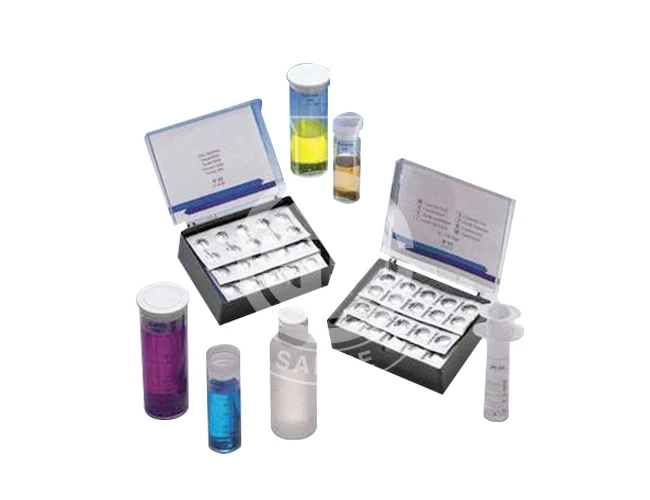
Rapid Tests - Minikit
Minikit - Lovibond
Highlights
Easy operation and exact reagent dosing
High accuracy
Foil-wrapped Lovibond® tablet reagents with a minimum guaranteed
Shelf life of 5 years
Unrestricted shipment
Safe storage
Analysis
- Alkalinity-M
- Alkalinity Caustic/P
- Alkalinity-P
- Calcium Hardness
- Chloride
- Cleaning Acid Strength
- Cyanuric Acid
- Hardness Total
- (very low range)
- Hardness Total
- (low range)
- Hardness Total
- (Yes/No)
- Hardness Total
- Nitrite
- Organo-Phosphonate
- QAC (Quaternary Ammonium Comp.)
- Sulphate (low range)
- Sulphate
- Sulphite (low range)
- Sulphite (high range)
- Tannin Index
The methods
The MINIKITs are designed for rapid water testing. Most MINIKITS are based on titrimetric methods.
The methods
In the tablet count method, the liquid titration solution and indicator are replaced by Lovibond® tablet reagents. A specific number of tablets is added to a defined sample volume until a chemically induced colour change takes place. The concentration of the parameter being measured is calculated from the number of tablets required. The measuring range can be expanded by varying the sample volume.
Yes/No test
Yes/No test tells the user whether a specific ingredient is present in the water and/or if its concentration is higher or lower than a defined level.
Turbidity method
A two-section calibrated test tube is filled with the water sample and a reagent tablet added.The reagent creates a level of turbidity that is proportional to the concentration of the parameter being measured. The inner tube, which has a black dot on its base, is lowered until the dot is obscured by the turbidity. The result is read off from the water level in the inner tube.
Speed test
The speed test is based on reverse titration. After adding a reagent tablet to a calibrated test tube, the water sample is added slowly until the colour of the solution changes (e.g. from red to blue). The user can then obtain the result from the liquid level.
Arsenic Test Kit (Highly Sensitive)
The arsenic test is due to its high sensitivity suitable for the determination of arsenic in drinking water.
The advantages at one view
- Sensitivity is according to the requirements of the WHO for drinking water quality. This test detects 0.005 mg/l Arsenic.
- The removal of the interfering sulfide ions is integrated in the test procedure. To minimize the potential danger for the user of the test kit it doesn’t use the highly toxic lead acetate for the sulfide removal.
- A solid acid substance is used in order to avoid any irritation by a corrosive acid on the user’s hands.
- The unbreakable plastic reaction vessel is more convenient and safe for on-site testing.
- During the test procedure the reaction vessel is tightly closed. The developing arsine gas cannot escape and therefore does not harm the user.
- The test kit contains a water-proof colour chart which also includes the brief instruction for use in pictograms. Even if there is a lack of knowledge in foreign languages everybody can now handle the test kit.
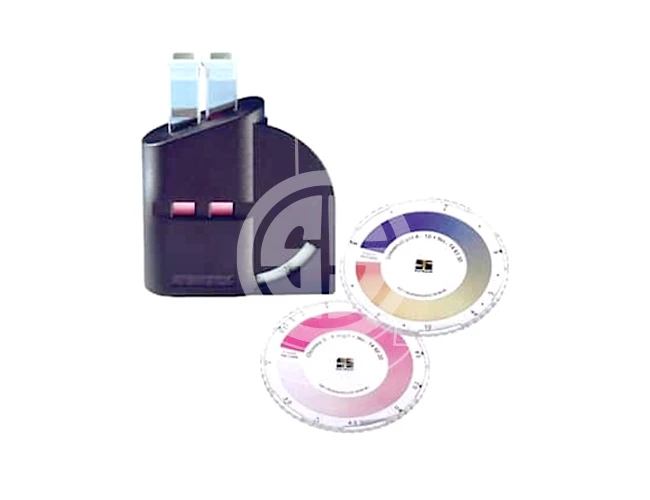
Checkit Comparator
CHECKIT® Comparator
Discs with continuous colour scale
Applications
- Water Treatment (e.g. Drinking Water)
- Pools
- Laboratory and Field Testing
- Special Applications
Highlights
- Easy operation
- Exact reagent dosing
- Tablet reagents with a minimum guaranteed shelf life of 5/10 years
- High accuracy
- Continuous colour scale
CHECKIT® Comparator
The Lovibond® CHECKIT® Comparator is a compact and handy colorimetric unit which is suitable both for mobile and stationary analysis work. Supplied with a generous number of different colour scales, it provides the basis for a comprehensive, easy-to-use colorimetric analysis system.
The CHECKIT® Comparator D55 enables the use of large path lengths. The mirror optics makes use of the view through the entire length of the cell.
CHECKIT® Disc
Each CHECKIT® Disc contains a continuous colour scale which makes it possible to achieve an exact colour match between the colour standard and the sample. These CHECKIT® Discs are specially manufactured in selected materials to remain
colour-stability over a long period and guarantee reliable, reproducible measurement results. Instruction manuals explaining the various stages of analysis in simple, straightforward terms, are supplied with each CHECKIT® Disc.
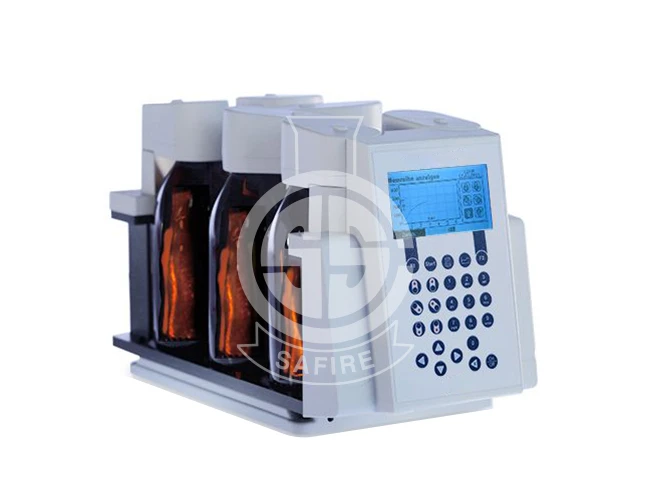
Bd 600 Bod Measurement System
BOD Measurement System BD 600
Accurate, automatic and direct control of your wastewater samples
Highlights
- User friendly
- Large brilliant graphic display
- Graphical representation of measured values
- USB & SD Card interface
- Mercury-free, environmentally-friendly
- Remote control
- User-selectable time span from 1 to 28 days
- Free individual programming of each of the six samples
- Inductive stirring system, 110 - 240 V / 50 - 60 Hz
Biochemical Oxygen Demand (BOD)
BOD – biochemical oxygen demand – is an expression for the quantity of oxygen required for biological degradation of organic matter in a waste water sample. BOD measurement is therefore used as a basis for the detection of biologically degradable organic matter in water. The difference between BOD and chemical oxygen demand (COD) is that COD additionally registers biologically non-degradable organic matter.
BOD measurement is therefore an important measurement of the effects of domestic and industrial waste water on sewage plants and outflow points.
Manometric, respirometric BOD measurement using the Lovibond® BD 600
The Lovibond® sensor system BD 600 is a 6 sample system that allows precise measurements of BOD based on the manometric principle. Manometric respirometers relate oxygen uptake to the change in pressure caused by oxygen consumption while maintaining a constant volume. Thanks to the modern integral pressure sensors, it is no longer necessary to use mercury for pressure measurements.
BD 600 Principle
Respirometric methods provide direct measurements of the oxygen consumed by microorganisms from an air or oxygen-enriched environment in a closed vessel under conditions of constant temperature and agitation. Carbon dioxide produced metabolically by the bacteria is chemically bound by the potassium hydroxide solution contained in the seal cup in the bottle.
The result is a pressure drop in the system, which is directly proportional to the BOD value and is measured by the BOD sensor. The BOD level is then displayed directly in mg/l.
The BOD values are stored automatically in the sensor memory in regulary intervals and can be called up on the large-format display at any time without the need for time-consuming conversion using factors. This means that test series that end on a Sunday can be evaluated during the following week without any problem. Measurement series can be stored on USB stick/SD card or transferred via USB cable to evaluate the datas on a computer.
The measurement period is user-selectable between 1 and 28 days to suit the application. While short measurement periods are useful for scientific applications, standard BOD measurements typically extend over a period of 5 days – and manometric determination of OECD, for example, generally takes place over a period of 28 days.
Evaluation of measurements
The BD 600 measuring system records a measurement once every hour, independent of the length of the measuring period. This way the quality of the series of measurement can be evaluated in an early stage. Current values and stored values may be called up at any time. Stored value can be displayed numerically or graphically. The table/ graph on the left illustrates an example of BOD5 evaluation. The development of BOD over a period of five days is easily seen.
Get in touch with us right now…
Our friendly customer service representatives are committed to answering all your questions and meeting you in person, if need be. We would love to hear from you! Please fill out the form to assist you.